EC3000 Down and Feather Identification Projector
Scope of Application
【Operating Instructions】
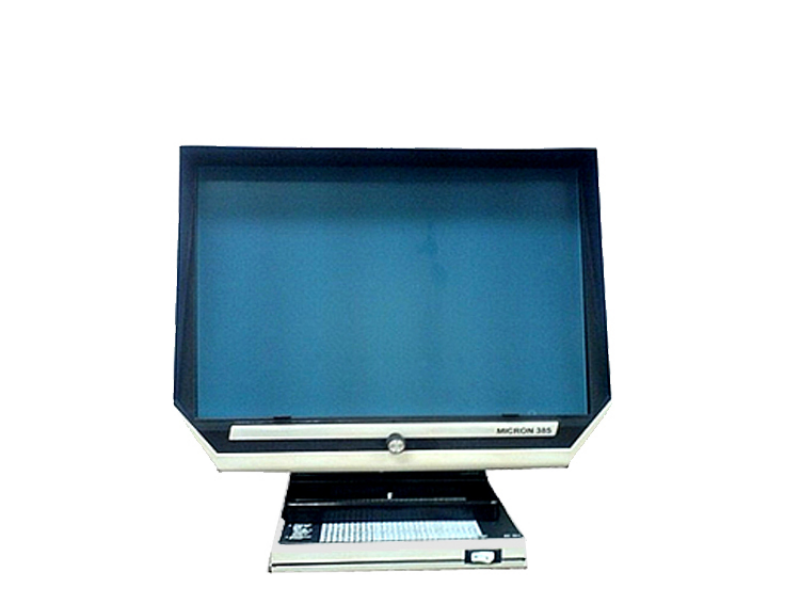
- The International Down and Feather Bureau (IDFB) has recommended the EC-3000 Microfiche Reader as the projector for distinguishing between goose and duck down (feathers). China's National Standard GB/T 10288-2003 also recommends the use of the EC-3000 Microfiche Reader. The EC-3000 projector is used in textiles, down and feather inspection, the automotive industry, small engines, agriculture, and other fields. When observed with a projector or microscope, the distal ends of the barbules at the base of duck down and feathers show triangular nodes (prismatic joints). Compared to the nodes of goose feathers (down), these are larger. The internodal distance is smaller, approximately equal to the size of the nodes.
Here is the professional English translation for the EC3000 Down and Feather Microfiche Reader/Projector and its accompanying instruction manual.
EC3000 Down and Feather Identification Projector
Applicable Scope:
The International Down and Feather Bureau (IDFB) has recommended the EC-3000 Microfiche Reader as the projector for distinguishing between goose and duck down (feathers). China's National Standard GB/T 10288-2003 also recommends the use of the EC-3000 Microfiche Reader. The EC-3000 projector is used in textiles, down and feather inspection, the automotive industry, small engines, agriculture, and other fields. When observed with a projector or microscope, the distal ends of the barbules at the base of duck down and feathers show triangular nodes (prismatic joints). Compared to the nodes of goose feathers (down), these are larger. The internodal distance is smaller, approximately equal to the size of the nodes.
Goose feathers (down): When observing their microscopic structure, the nodes are smaller and start to appear from the middle of the barbules. The internodal distance is larger, several times the size of the nodes.
Compliance Standards:
GB/T 14272-2011, GB/T 10288, FZ/T 80001, IDFB, etc.
Technical Parameters:
Screen: 280mm (H) × 356mm (W)
Film Carrier: Automatic opening, 106mm × 153mm, compatible with both flat and mounted films.
Magnification: Drop-in interchangeable lenses: 21x, 24x, 32x, 42x, 48x, 64x, 72x.
Weight: 6kg
Dimensions: 444mm (H) × 406mm (W) × 457mm (D)
Light Source: FLT 28W 13.8V
Power Supply: AC 220V or AC 110V
EC-3000 Microfiche Reader Instruction Manual
The International Down and Feather Bureau (IDFB) has recommended the EC-3000 Microfiche Reader as the projector for distinguishing between goose and duck down (feathers). China's National Standard GB/T 10288-2003 also recommends the use of the EC-3000 Microfiche Reader.
The national standard observation and identification methods are as follows:
1. Identification of Goose and Duck Feather/Down Types
1.3.1 Place the down clusters from Beaker H (refer to section 1.2.2) into the sample tray, mix evenly, and spread flat. Randomly extract samples from multiple points weighing more than 0.1g.
1.3.2 Mix the feathers from Beaker A (refer to section 1.2.1) evenly and spread them flat in the sample tray. Randomly extract samples from multiple points weighing more than 1.0g. If the preliminary sorted feathers weigh less than 1.0g, use all of them as the sample for inspection. For samples with a down content greater than or equal to 90%, feather inspection may be omitted.
1.3.3 Label two 250ml beakers as A1 and B1 respectively. Using tweezers, take out the down clusters and feathers, organize them separately, and remove any down fibers or other debris adhering to them. Observe and identify them under a projector or microscope according to the method specified in 1.3.4. Place the identified duck feathers (down) and goose feathers (down) into beakers A1 and B1 respectively. Classify any "indistinguishable feathers (down)" into beaker B1. Weigh the contents of each beaker to the nearest 0.1mg.
1.3.4 Observation and identification methods are as follows:
1.3.4.1 Duck feathers (down)
When observed with a projector or microscope, the distal ends of the barbules at the base of the down clusters and feathers show triangular nodes. Compared to the nodes of goose feathers (down), these are larger. The internodal distance is smaller, approximately equal to the size of the nodes (see Figure 2).
1.3.4.2 Goose feathers (down)
When observing their microscopic structure, the nodes are smaller and start to appear from the middle of the barbules. The internodal distance is larger, several times the size of the nodes (see Figure 2).
1.3.4.3 Chicken feathers
When observed under a projector or microscope, a series of small nodules or swollen protrusions are evenly distributed on the barbules. These swollen protrusions are distributed along almost the entire length of the barbule. Chicken feathers are classified as terrestrial bird feathers.
1.3.4.4 Pigeon feathers
When observed under a projector or microscope, a series of nodes are evenly distributed on the barbules. The internodal distance is large, several times the size of the nodes. The nodes are distributed along almost the entire length of the barbule. Pigeon feathers are classified as terrestrial bird feathers.
1.3.4.5 Indistinguishable feathers (down)
When observed under a projector or microscope, there are no obvious nodes, making it impossible to distinguish whether they belong to goose feathers (down), duck feathers (down), or other types of feathers (down).
1.3.5 The calculation of the duck feather (down) content within the goose feather (down) is shown in Formula (10):
(Note: The specific formula was not provided in the original text, but the variables are defined below)
Where:
A1 — Mass of duck feathers (down), in grams (g);
B1 — Mass of goose feathers (down), in grams (g).
1.3.6 Inspect and calculate the results for the second sample following the steps in 1.3.1 to 1.3.5. Take the average of the results from the two samples as the final result, rounded to two decimal places.
Eye Com 3000 Full-Size COM Microfiche Reader Operation and Instrument Instructions
Thank you very much for purchasing the Eye Com 3000 Full-Size COM Microfiche Reader. To ensure the correct use of this equipment, please read the user manual first and keep it for future reference.
Unboxing:
Open the box lid and remove the instrument from the carton.
Remove the plastic foam padding.
Remove the magnetic coordinate board.
Open the film carrier until the top glass opens.
Remove the cardboard insert from the middle.
Remove the warranty card (fill it out and send it to the agent or manufacturer).
Remove the protective tape from the screen.
Dual lens mode (Not applicable).
Operating Instructions:
Plug in the power and turn on the machine.
Open the film carrier until the glass opens.
Place the item to be observed inside.
Focus and observe the screen.
Bulb Replacement:
Unplug the power.
Tilt the projector backward 90 degrees so the bottom faces forward.
Open the bulb cover on the bottom of the machine.
Pull out the bulb (Note: You must let the bulb cool down before touching it with your hands).
Insert a new bulb of the same model and part number. Do not touch the glass or the reflector of the bulb with your bare hands.
Instrument Maintenance:
The screen, upper and lower glass plates, lenses, and reflector of the Eye Com projector require regular cleaning.
Please refer to the illustrations in the manual for specific maintenance instructions.