GB 15979—2024 "Hygienic requirements for disposable sanitary products
**GB 15979—2024 "Hygienic requirements for disposable sanitary products"**

This standard replaces GB 15979—2002 "Hygienic standard for disposable sanitary products" and will be implemented from July 1, 2025. The new national standard GB 15979—2024 clearly defines disposable sanitary products and specifies hygienic requirements, including those for raw materials, production environment, and product hygiene indicators. Relevant organizations are advised to pay attention to the content of this new national standard and ensure their products comply with its requirements.
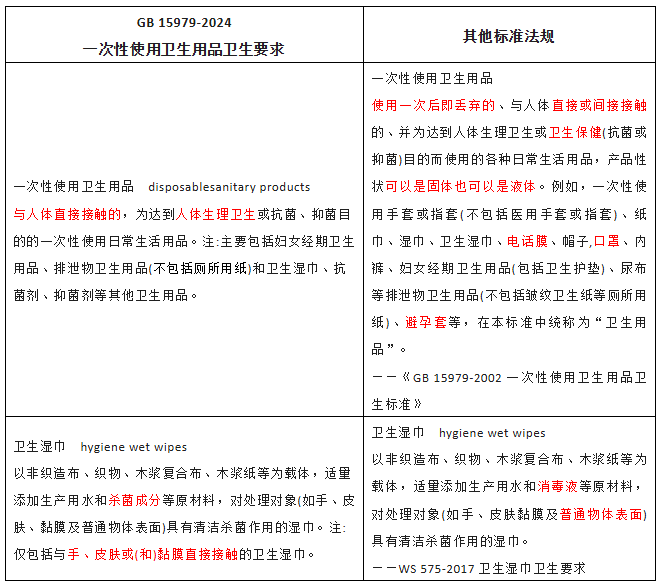
Disposable sanitary products refer to various daily-use items intended for single use, discarded after one use, which come into direct or indirect contact with the human body. Their purpose is to achieve personal physiological hygiene or health care (including antibacterial or bacteriostatic effects). These products may be solid or liquid.
Examples of disposable sanitary products include: disposable gloves or finger cots (excluding medical gloves or finger cots), tissues, wet wipes, sanitary wet wipes, telephone covers, caps, masks, underwear, women's menstrual hygiene products (including panty liners), diapers and other excrement-handling sanitary products (excluding toilet paper like crepe toilet paper), condoms, etc.
GB 15979—2024 replaces GB 15979—2002 "Hygienic standard for disposable sanitary products". Compared with GB 15979—2002, the main technical changes are as follows:

— The standard title has been changed to "Hygienic requirements for disposable sanitary products";
— The scope of application has been modified within the Scope clause, adding inapplicable situations;
— Normative references cited in this standard have been added;
— The definition of disposable sanitary products has been adjusted, and definitions for sanitary wet wipes, production workshop, and superabsorbent materials have been added;
— Requirements for prohibited and restricted substances and water for production have been added to the raw material hygiene requirements;
**1. Raw materials shall not contain the following prohibited substances:**
a) Drugs listed in the "Pharmacopoeia of the People's Republic of China" and their ingredients with the same name, such as antibacterial drugs, antifungal drugs, antiviral drugs, hormonal drugs, and their ingredients with the same name;
b) Vaccines, sera, toxins, or their derivatives; preparations used for diagnosing immune status; proteins, polypeptide preparations;
c) Prohibited chemical substances listed in the "Safety and Technical Standards for Cosmetics";
d) Migratory fluorescent whitening agents;
e) Other substances prohibited for use as stipulated by the National Health Commission.

**2. Water for production shall meet the quality standards for corresponding products**
a) Water for the production of wet wipes, sanitary wet wipes, and antibacterial (bacteriostatic) agents shall meet purified water requirements;
b) Water for the production of other disposable sanitary products shall meet the requirements of GB 5749 and enterprise specifications.
— The original indicators for production environmental hygiene, biological monitoring evaluation of disinfection effect, and initial contaminating bacteria in product hygiene indicators have been consolidated and adjusted into requirements for production process hygiene. The original requirements for production environment and process hygiene, as well as disinfection process requirements, have been deleted.
— Physical and chemical indicators have been added to the product hygiene requirements. Microbiological indicators for antibacterial agents, bacteriostatic agents, and tampons have been adjusted. Toxicological test items and toxicological indicator requirements have been moved from the appendix to the main text.
**1.** Based on the characteristics, purpose, and health risks of different products, physical and chemical requirements have been added, including physical and chemical indicators and usage concentrations of restricted substances.
**2.** Toxicological test items have been refined according to the product's purpose and the type of skin or mucous membrane contact (intact, damaged, etc.).
**3.** It is specified that disposable sanitary products intended for use by pregnant women or infants shall undergo a skin sensitization test.
**4.** It is specified that for products intended for infants, toxicological test results for skin irritation and eye irritation shall be non-irritating, and no skin sensitization shall be observed.
**5.** Ordinary women's menstrual hygiene products have been divided into "tampons (internal)" and "other women's menstrual hygiene products", with microbiological indicators specified separately according to risk level.
**6.** Requirements for bacterial colony count and fungal colony count in antibacterial (bacteriostatic) agents have been tightened.

— Test methods for the physical and chemical indicators of related products have been added to the inspection methods section.
— The air sampler method has been added to Appendix A "Test method for production environmental hygiene requirements". The test method for product ethylene oxide residues in Appendix C has been updated and optimized. In Appendix D "Test method for product bactericidal performance, bacteriostatic performance, and stability", the sample collection quantity has been adjusted, some antibacterial (bacteriostatic) test methods have been added, and the bactericidal and bacteriostatic action times have been adjusted. In Appendix E "Test method for product toxicology", the sample processing method for the eye irritation test has been added. In Appendix F "Test method for product microbiology", the fungal detection method has been adjusted. Appendix G "Preparation of media and reagents" has been deleted.
(Reposted from the "Testing" WeChat platform, thanks to the original author!)