"Moisture Permeability (Vapor Transmission)" with "Air Permeability" – They Are Entirely Different Concepts!
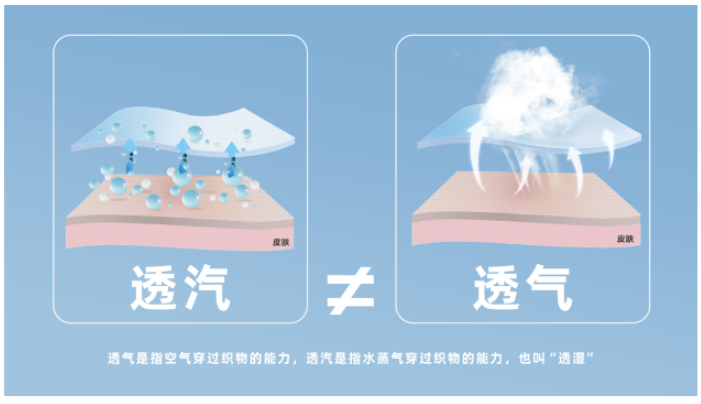
**Many People Confuse "Moisture Permeability (Vapor Transmission)" with "Air Permeability" – They Are Entirely Different Concepts!**
Both are crucial factors affecting comfort. Today, let's talk about what **air permeability** really is.
**1. What is Air Permeability?**
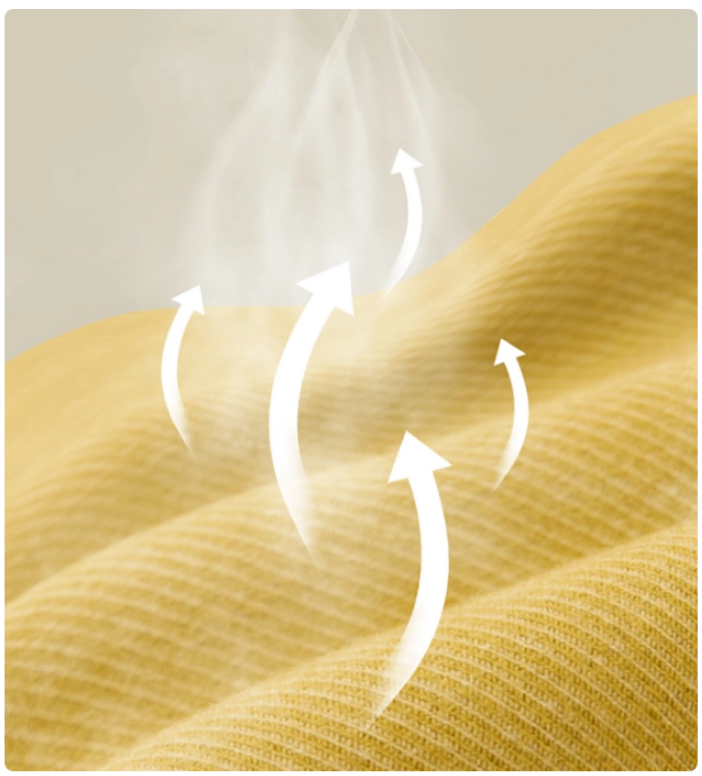
By definition, **air permeability** refers to the ability of gases to permeate through polymer materials such as films, coatings, and fabrics. On the other hand, **"vapor transmission"** refers to the ability of water vapor to pass through a fabric, also known in the industry as **"moisture permeability"**. Only when both air permeability and moisture permeability are adequate can we achieve comfortable sensations.
**Fabric air permeability** is the property of air to pass through a fabric when there is a pressure difference between its two sides. Specifically, it is the volume of air flowing through a unit area of fabric per unit time under a specified pressure difference, commonly expressed in mm/s. The pressure difference is essential for air to flow; it must be maintained between the two sides of the tested fabric to generate airflow through it.
**2. What are the Test Standards for Air Permeability?**
Commonly used test methods for air permeability include:
* GB/T 5453-1997 "Textiles – Determination of permeability of fabrics to air"
* ISO 9237:1995 "Textiles – Determination of permeability of fabrics to air"
* ASTM D737-2018 "Standard Test Method for Air Permeability of Textile Fabrics"
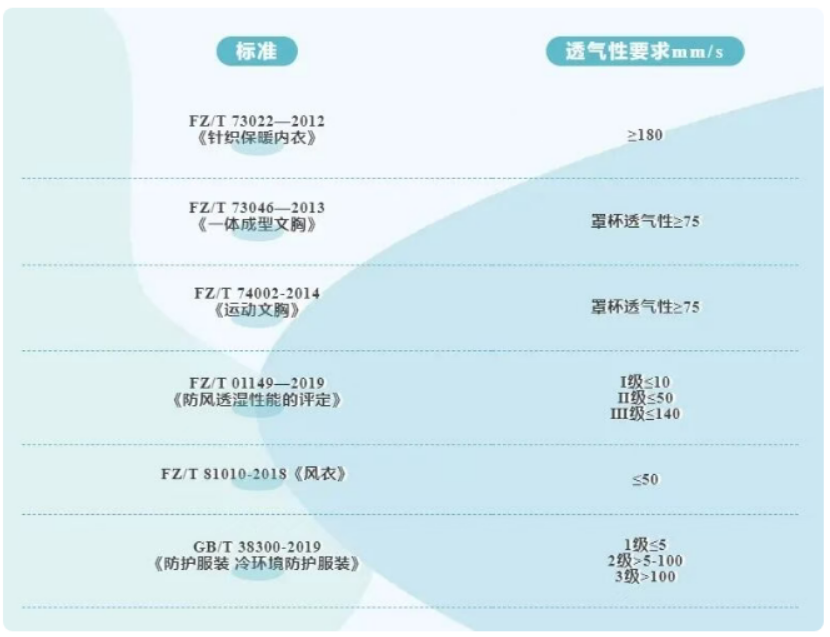
Internationally, air permeability requirements are typically specified by buyers based on the product category. In China, there is currently no unified mandatory regulation for air permeability, but some product standards or evaluation standards do include relevant requirements, as shown in the table below.
**Air Permeability Requirements in Relevant Domestic Standards:**
| Standard | Requirement |
| :--- | :--- |
| (Placeholder for specific standards and values) | (Placeholder) |
**3. Factors Affecting Air Permeability**
**Fabric-Related Factors:**
1. **Fiber Shape and Yarn Structure:** When warp and weft yarn linear density and warp density are the same, fabrics made from profiled fibers generally exhibit better air permeability than those made from circular cross-section fibers. Coarser single fibers within the yarn also lead to higher permeability compared to finer ones.
2. **Fabric Structure:** Under identical density and tightness conditions, the order of air permeability from lowest to highest is typically: Plain weave < Twill weave < Satin weave < Porous weaves (e.g., honeycomb).
3. **Finishing Processes:** Printing and dyeing treatments tend to tighten the fabric structure, reducing air permeability. Conversely, processes like weight reduction treatment can make fibers finer and increase the pores between fibers and yarns, thereby increasing air permeability.
**Environmental Factors:**
1. **At Constant Temperature:** Fabric air permeability tends to decrease as relative humidity increases. When fabric absorbs moisture, fibers swell, and pores contract, reducing the internal pore space and sometimes blocking pores, leading to lower air permeability.
2. **At Constant Relative Humidity:** Air permeability increases with rising ambient temperature. Increased thermal motion of gas molecules enhances their diffusion capability.
3. **When Temperature and Relative Humidity are Constant:** Changes in the air pressure difference (ΔP) across the fabric can non-linearly affect the measured airflow rate.
**Conclusion:**
Air permeability is a vital component of fabric breathability. It is essentially related to the size of the pores and interstices within the fabric structure. Different fabric applications require different levels of air permeability performance.
---
*Reposted from | Hubei Fiber Inspection Bureau*
*Editors | Zhang Yaling, Hou Chunting*
*Proofreader | Xue Xun*
*Reviewer | Ge Jiawen*
*Reposted from the [China Fiber Inspection] WeChat platform. Thanks to the original author!*
现在有很多人把“透湿(透汽)”
叫做“透气”
其实这是完全不同的两种概念
他们都是影响体感舒适的重要因素
今天纤纤就来和大家讲讲
什么是透气性
什么是透气性
从定义来讲:透气性是指气体对薄膜、涂层、织物等高分子材料的渗透性。而“透汽”是指水蒸汽穿过织物的能力,业内也叫“透湿”。只有透气性和透汽性都满足才能获得舒适的体感。

织物透气性,是指织物两面存在压差的情况下,空气透过织物的性能。即织物两面在规定的压力差下,单位时间内流过织物单位面积的空气体积,常用单位为mm/s。因为压差是空气赖以流动的必要条件,只有在被测织物两面保持一定的压差,才能在织物中产生空气流动。

透气性的检测标准有哪些?
目前,国内外常用透气性测试方法主要有GB/T 5453-1997《纺织品 织物透气性的测定》、ISO 9237:1995《纺织品 织物透气性的测定》、ASTM D737-2018《纺织品 织物透气性的试验方法》等。

国外对于透气性的指标要求通常是由买家根据产品类别的需要自行规定,我国对于透气性目前没有统一的规定,但某些产品标准或评价标准中也有相应要求,见下表:
国内相关标准的透气性要求:

影响透气性能的影响因素
织物因素:
1.纤维形态和纱线结构:在经纬纱的线密度和经纱排列密度相同时,异形纤维织物优于圆形截面纤维织物,织物中单纤粗的比单纤细的透气性好。
2.织物组织结构:在相同的排列密度和紧度的条件下,透气性强弱排列顺序为平纹<斜纹<缎纹<多孔组织。
3.织物的后整理加工:织物印染整理,织物结构变紧,透气性下降;减量处理,织物纤维变细,纤维及纱线间孔隙加大,透气性增大。
环境因素:
1.温度一定时:织物透气量随空气的相对湿度的增加而呈下降趋势。织物吸收水分后,纤维膨胀、气孔收缩,使织物内部的孔隙减少,织物中孔隙阻塞,导致织物透气量下降。
2.相对湿度一定时,织物透气量随环境温度升高而升高。气体分子的热运动加剧,导致分子扩散能力增加。
3.当温度和相对湿度不变时,织物两面的气压P发生变化,会影响实测的流量,而且影响是非线性。
总结:透气性是织物透通性的重要组成部分。织物的透气性能实质上与织物中纤维间的空隙大小有关,对于不同用途的面料,要求其不同的透气性能。
转 自 | 湖北省纤维检验局
编 辑 | 张亚玲 侯春婷
校 对 | 薛训
审 核 | 葛嘉文
转载自【中国纤检】微信平台,感谢原作者!