Interpretation of the Test Standard for Colour Fastness to Splicing Dye Transfer:GB/T 31127
**Guide**
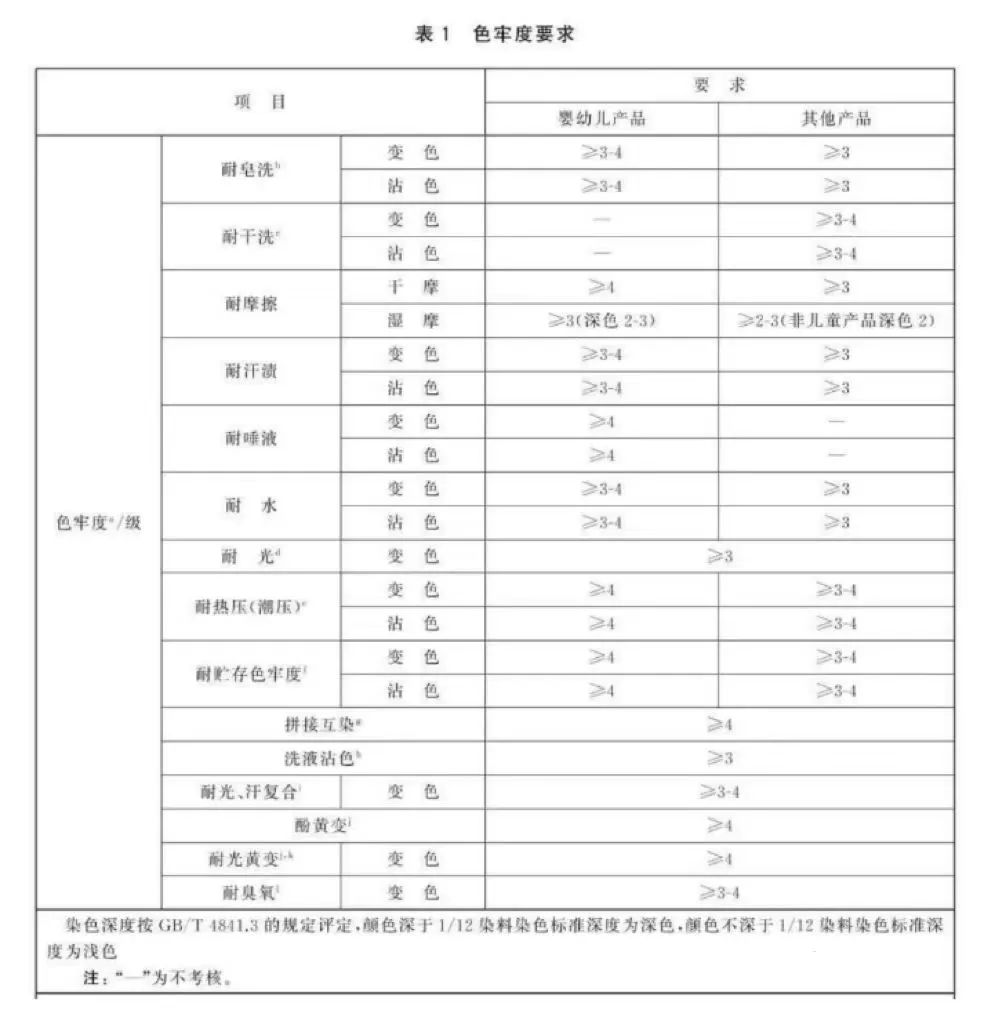
The colour transfer fastness of finished products at the splicing point needs to be tested according to the GB/T 31127-2014 standard, i.e., "Textiles — Tests for colour fastness — Colour fastness to splicing dye transfer".
**1. Requirements for Colour Fastness to Splicing Dye Transfer Grade**
Requirements
(Image: GB T 31127.jpg)
**2. Differences from the Previous Version Requirements**
Among the physical and chemical property testing items for garments, colour fastness to washing, dry cleaning, rubbing, perspiration, saliva, water, and artificial light are all relatively basic test items.
Referring to the indicator value settings of numerous garment product standards such as GB 18401-2010, GB 31701-2015, GB/T 14272-2021, GB/T 2660-2017, FZ/T 81006-2017, FZ/T 81007-2012, combined with rich testing data from recent years and the long-term implementation status of GB/T 21295-2014, the assessment indicators for colour fastness to washing, dry cleaning, rubbing, perspiration, saliva, water, and artificial light will continue to use the indicator values from GB/T 21295-2014. Furthermore, the colour fastness items from the original Table 1 and the original Table 3 are merged into one table (Table 1), listing the specific indicator values. Notably, for colour fastness to washing, a remark has been added: "Products marked as non-washable in the care instructions are not assessed."
**2. Test Principle and Scope**
**1. Scope of Test**
This standard describes two methods for testing the colour fastness at the splicing point of textiles: the washing method and the soaking method. It is mainly applicable to textiles assembled by splicing dark and light colored fabrics. Non-spliced textiles may also refer to this method.
**2. Test Principle**
2.1. **Washing Method (using a colour fastness to washing tester)**
Place the specimen in a specified washing liquor and subject it to mechanical agitation under specified conditions of liquor ratio, time, and temperature. Subsequently, rinse and dry the specimen. Finally, assess the staining of the specimen using the grey scale for assessing staining or an instrument.
2.2. **Soaking Method (using a colour fastness to perspiration tester)**
Place the specimen in a specified washing liquor. After relevant treatment, place it between two flat plates in the test device under a specified pressure. Subsequently, rinse and dry the specimen. Finally, assess the staining of the specimen using the grey scale for assessing staining or an instrument.
**3. Apparatus and Consumables Used**
The instruments and consumables used are as follows:
**Test Apparatus A (Colour Fastness to Washing Tester):**
The mechanical washing device consists of a water bath containing a rotating shaft. Radially mounted on this shaft are several stainless steel containers, each with a capacity between 500 mL and 600 mL, a diameter of 70 mm to 80 mm, and a height of 115 mm to 135 mm. The distance from the center of the rotating shaft to the bottom of the container is approximately 35 mm to 55 mm. The rotation speed of the shaft and containers is maintained between 38 and 42 revolutions per minute. The temperature of the water bath is controlled by a thermostat to ensure the test solution remains within ±2°C of the specified temperature.
(Image placeholder)
**Test Apparatus B (Colour Fastness to Perspiration Tester)**
2.1. **Stainless Steel Rack**
When the combined specimen dimensions are (40 mm ± 2 mm) × (100 mm ± 2 mm), it is placed between two plates and subjected to a pressure of (12.5 kPa ± 0.9 kPa). If the combined specimen dimensions differ, the weight used to apply pressure shall be such that the nominal pressure on the specimen remains (12.5 kPa ± 0.9 kPa). The test device shall be designed so that the pressure on the specimen remains constant after the weight is removed.
2.2. **Weight**
Mass approximately 5 kg, base area 60 mm × 115 mm (consistent with national standard and ISO).
2.3. **Glass or Acrylic Resin Plates**
Glass or acrylic resin plates, dimensions approximately 60 mm × 115 mm × 1.5 mm, 11 pieces total.
2.4. **Corrosion-Resistant Flat-Bottomed Container (Test Solution Box)**
(Image placeholder)
3. **Constant Temperature Oven (Perspiration Fastness Oven):**
Maintains a temperature of (37 ± 2)°C and can accommodate at least one set of stainless steel racks.
(Image placeholder)
4. **Balance**, accurate to ±0.01 g
(Image placeholder)
5. **Preheating Device for Washing Liquor**
Water bath or automatic liquid dispensing machine.
6. **ECE Reference Detergent** (without fluorescent whitening agent)
7. **Grade 3 Water**, conforming to GB/T 6682. Use a laboratory pure water system or ultrapure water system.
(Image placeholder)
8. **Filter Paper**, conforming to GB/T 1914
9. **Grey Scale for Assessing Staining**, conforming to GB 251
(Image placeholder)
10. **Spectrophotometer or Colorimeter**, conforming to GB/T 01023, for assessing staining.
**4. Sampling**
Cut one specimen, approximately 100 mm × 40 mm (with a permissible tolerance of ±2 mm), from each of the two fabric samples to be spliced. Then, place these two specimens with their right sides together and sew them together along one of the short sides to form a combined specimen. If the finished product is already sewn and does not affect the pressure requirements of the test method on the specimen, this combined sample can be cut directly from the spliced area.
**5. Procedure**
**1. Method A – Washing Method**
1.1. Weigh 4 g of ECE reference detergent using a balance, prepare 1 L of washing liquor with Grade 3 water, and preheat it to (40 ± 2)°C for use.
Place the combined specimen and the preheated washing liquor into a wash container according to a liquor ratio of 50:1. Load the container into Test Apparatus A (colour fastness to washing tester) and run for 30 minutes at a temperature of (40 ± 2)°C.
Note: Other test temperatures may be used upon agreement between the interested parties, but this must be stated in the test report.
1.2. After washing, remove the combined specimen, rinse it thoroughly with running water, then squeeze out excess water. Finally, absorb excess moisture using filter paper.
1.3. Use a clip to hold the unsewn end of the dark-colored specimen and hang it to dry in air at a temperature not exceeding 60°C.
1.4. Assess the staining on the light-colored specimen using the grey scale for staining (GB/T 251) or an instrument.
**2. Method B – Soaking Method**
2.1. Weigh 4 g of ECE reference detergent using a balance, prepare 1 L of solution with Grade 3 water, and cool it to room temperature.
2.2. Place one combined specimen flat in a flat-bottomed container. Inject the solution prepared in 2.1 to wet it completely, maintaining a liquor ratio of 50:1. Leave it at room temperature for 30 minutes, occasionally pressing and moving the specimen to ensure the test solution penetrates the specimen fully and uniformly. Remove the specimen, discard the residual liquid, and use two glass rods to remove excess test solution from the combined specimen.
2.3. Place the combined specimen flat between two glass or acrylic resin plates in Test Apparatus B (colour fastness to perspiration tester), ensuring the specimen is under vertical pressure of (12.5 ± 0.9) kPa.
Note: Each test apparatus can hold a maximum of 10 combined specimens simultaneously for testing, with each specimen separated by one plate (using 11 plates total). If fewer than 10 specimens are used, still use 11 plates to maintain the nominal pressure unchanged.
2.4. Place Test Apparatus B (colour fastness to perspiration tester) containing the combined specimens into a constant temperature oven (perspiration fastness oven) at a temperature of (37 ± 2)°C for 4 hours, with the combined specimens placed horizontally.
2.5. After soaking, remove the combined specimen, rinse it thoroughly with running water, then squeeze out excess water. Finally, absorb excess moisture using filter paper.
2.6. Use a clip to hold the unsewn end of the dark-colored specimen and hang it to dry in air at a temperature not exceeding 60°C.
2.7. Assess the staining on the light-colored specimen using the grey scale for staining (GB/T 251) or an instrument.
Note: Generally, the staining grade from the soaking method test is much more severe than that from the washing method.
**6. Analysis of Staining Causes and Prevention**
**Analysis of Causes for Splicing Dye Transfer**
1.1. Staining on light-colored fabric is mainly caused by color fading from the dark-colored fabric. If the dark-colored fabric itself has poor fastness, or if inappropriate processes and auxiliaries are used, it can easily lead to staining of the solution during washing. The light-colored fabric then absorbs the stained solution, causing cross-staining.
1.2. If the fabric is stretch fabric, spandex does not dye easily and tends to have surface-adsorbed dye. If the reduction clearing is insufficient, it can also lead to cross-staining between fabrics.
1.3. If the dark and light fabrics are made of the same fiber component, cross-staining between the shades can also occur, especially with polyester fabric. This phenomenon is particularly noticeable and is caused by their mutual chemical interaction. This is not necessarily a problem with the fabric's colour fastness, but a defect arising from the garment's design.
**2. Preventive Measures in Daily Life**
2.1. For solid-colored garments, it is recommended to wash dark and light colored clothes separately, and the soaking time should not be too long, approximately 5-10 minutes.
2.2. Choose neutral detergents; try to avoid alkaline detergents, as alkaline detergents can cause hydrolysis of certain dyes.
2.3. The color change and staining of multi-colored garments are also affected by factors such as soaking time, storage conditions, improper washing, and inadequate drying. The GB/T 31127-2014 standard "Textiles — Tests for colour fastness — Colour fastness to splicing dye transfer" does not explicitly specify under which circumstances to choose which test method. Therefore, when selecting this standard to test the splicing dye transfer fastness of assembled garments, enterprises should choose based on the requirements of their own products in conjunction with relevant considerations.
Note: This article is reproduced from the "Yunxiang Testing Service" platform!
---------------------------------------------------------------------------------------------------------------
导读
成品在拼接处的颜色迁移牢度需依据GB/T31127-2014标准,即《纺织品色牢度试验 拼接互染色牢度》进行测试。
1.对于拼接互染色牢度等级的要求
要求
2.与之前版本要求的区别
在服装的理化性能检测项目里,耐皂洗、耐干洗、耐摩擦、耐汗渍、耐唾液、耐水色牢度以及耐人造光色牢度都属于较为基础的检测项目。
参照GB18401 - 2010、GB 31701 - 2015、GB/T 14272 - 2021、GB/T 2660 - 2017、FZ/T81006 - 2017、FZ/T 81007 - 2012等众多服装产品标准的指标值设定情况,再结合近几年丰富的检测数据以及GB/T21295 - 2014长时间的执行状况,对于耐皂洗、耐干洗、耐摩擦、耐汗渍、耐唾液、耐水色牢度、耐人造光色牢度的考核,继续沿用GB/T21295 - 2014中的指标值。并且把原表1里的色牢度项目和原表3合并成一张表(表1),将具体的指标值列出。其中,耐皂洗色牢度添加了“不考核使用说明中标注不可水洗的产品”这样一条备注。
2.测试原理及范围
测试范围
本标准介绍了两种测试纺织品拼接处颜色牢固度的方法,分别是洗涤法和浸泡法。它主要适用于深、浅色织物拼接的纺织品。不是拼接的纺织品也可以参考这个方法。
2、测试原理
2.1、洗涤法(使用耐洗色牢度仪)
将试样放置于规定的洗涤液里,按照规定的浴比、时长以及温度条件进行机械搅动。之后,对其进行清洗和干燥处理,最后运用评定沾色用灰色样卡或者仪器来评定试样的沾色情况。
2.2、浸泡法(使用汗渍色牢度仪)
把试样放置在规定的洗涤液当中,经过相关处理之后,将其放在试验装置内两块带有规定压力的平板之间。随后,进行清洗和干燥操作,最后使用评定沾色用灰色样卡或者仪器来评定试样的沾色情况。
3.所用设备及耗材
| 所用仪器及耗材如下表: | |
机械洗涤设备包含一个装有旋转轴杆的水浴锅。这根旋转轴上呈放射状安装着多个不锈钢容器,每个容器的容量都在500mL到600mL之间,直径为70mm到80mm,高度为115mm到135mm。从旋转轴的中心到容器底部的距离大约是35mm到55mm。轴和这些容器的旋转速度保持在每分钟38转到42转之间。水浴的温度由一个恒温器来调节,确保试验溶液的温度始终保持在规定温度的±2℃范围内。 | |
2.1、不锈钢架 当组合试样的尺寸为(40mm加减2mm)乘以(100mm加减2mm)时,它被夹在两块板之间会受到(12.5kPa加减0.9kPa)的压强。如果组合试样的尺寸不是这个范围,那么用来施加压力的重锤应确保试样受到的名义压强仍然是(12.5kPa加减0.9kPa)。试验装置的设计要确保在移开重锤后,试样所受的压强能够保持稳定不变。 2.2、砝码 质量约5kg、底部面积为60mm×115mm,(国标与ISO一致) 2.3、玻璃板或丙烯酸树脂板 尺寸约 60mmx115 mmx1.5 mm的玻璃板或丙烯酸树脂板,共11块 2.4、耐腐蚀平底容器(试液盒) | |
3 、恒温箱(汗渍色牢度烘箱): 保持温度在(37±2)℃,至少放下一组不锈钢架。 | |
4 、天平,精确至±0.01 g | |
3 、预热洗涤液的装置 水浴锅或者智能加液机 | |
6、ECE标准洗涤剂(不含荧光增白剂) | |
7、三级水,符合GB/T6682,使用实验室纯水机或者超纯水机。 | |
8、滤纸,符合GB/T 1914 | |
9、 灰色样卡,用于评定沾色,符合GB251 | |
10、分光光度测色仪或色度计,符合GF/T 01023,评定沾色。 |
4.取样
从两块待拼接的织物样品上,各自裁剪出一块大小约为100毫米乘40毫米(允许有±2毫米的误差)的试样,然后把这两块试样的正面相互贴合,并沿着其中一条短边将它们缝合起来,形成一个组合试样。如果成品已经缝合,并且不影响测试方法对试样受压的要求,那么可以直接在拼接的地方剪取这个组合样。
5.操作
1.方法A--洗涤法
1.1用天平称取4g的ECE标准洗涤剂,与三级水配制成1L洗涤液,并预热至(40±2)℃备用。
将组合试样和预热的洗涤液按浴比50:1放入洗杯中,装入试验装置A(耐洗色牢度仪)中,于(40±2)℃温度下运转 30 min。
注:经相关方协议同意后也可采用其他试验温度,但应在试验报告中说明。
1.2洗涤结束后取出组合试样,用流动水冲洗至干净,然后挤去过量水分,最后用滤纸吸取多余水分。
1.3用一个夹子夹住深色试样未缝合的一端,悬挂在不超过60℃的空气中干燥
1.4、用沾色灰卡(GBT521)或仪器评定浅色试样的沾色
2.方法 B--浸泡法
2.1、用天平称取4g的ECE标准洗涤剂,与三级水配制成1L溶液,冷却至室温。
2.2、将一块组合试样平放在平底容器内,注入2.1所配制溶液使之完全润湿,浴比为50:1。在室温下放置 30min,不时压和拨动,以保证试液能充分且均匀地渗透到试样中。取出试样,倒去残液,用两根玻璃棒夹去组合试样上过量的试液。
2.3、将组合试样平置在试验装置B(汗渍色牢度仪)的两块玻璃或丙烯酸树脂板中间,使试样垂直受压(12.5+0.9)kPa。
注:每台试验装置最多可同时放置10块组合试样进行试验,每块试样间用一块板隔开(共11块)。如少于10 个试样,仍使用11块板,以保持名义压强不变。
2.4、将含有组合样的试验装置B(汗渍色牢度仪)放入恒温箱(汗渍色牢度烘箱)中,在(37±2)℃的温度下放置4h,组合试样呈水平放置状态。
2.5、洗涤结束后取出组合试样,用流动水冲洗至干净,然后挤去过量水分,最后用滤纸吸取多余水分。
2.6、用一个夹子夹住深色试样未缝合的一端,悬挂在不超过60℃的空气中干燥。
2.7、用沾色灰卡(GBT521)或仪器评定浅色试样的沾色。
注:一般浸泡法试验的沾色级数要比洗涤法严重很多。
6.染色原因分析及预防
拼接染色原因分析
1.1、浅色面料沾色主要是由于深色面料褪色引起的。若深色面料本身牢度就不好,所用的工艺及助剂不对,就容易引起面料洗涤过程中出现溶液沾色的情况,浅色面料对沾色后溶液进行吸附从而引起的互染。
1.2、若面料为弹力面料,氨纶是不容易上色的,就容易存在浮色,若还原洗不充分,也会引起面料间的互染。
1.3、若深浅面料是同种成分,也会引起深浅色间的互染,尤其是涤纶面料,这种情况特别明显这是其相互化学作用引起的。这并不是面料色牢度存在的问题,而是服装本身设计缺陷造成的。
2、生活中预防措施
2.1、若为单色服装,建议深、浅色衣服分开洗涤,且浸泡时间不宜过长,大约5-10分钟;
2.2、选择中性洗涤剂,尽量不使用碱性洗涤剂,碱性洗涤剂会使某些染料发生水解;
2.3、拼色服装的变、沾色现象也受浸泡时间长、储存条件、洗涤不当、晾干不妥等因素的影响,GB/T 31127-2014《纺织品色牢度试验拼接互染色牢度》标准中并没有明确指出在什么样的情况下选择哪种试验方法。因此,在选择此标准进行检测拼接服装的拼接互染色牢度时,企业应根据自身所生产的产品要求相互结合。注:本文转载于“云享测试服务”平台!