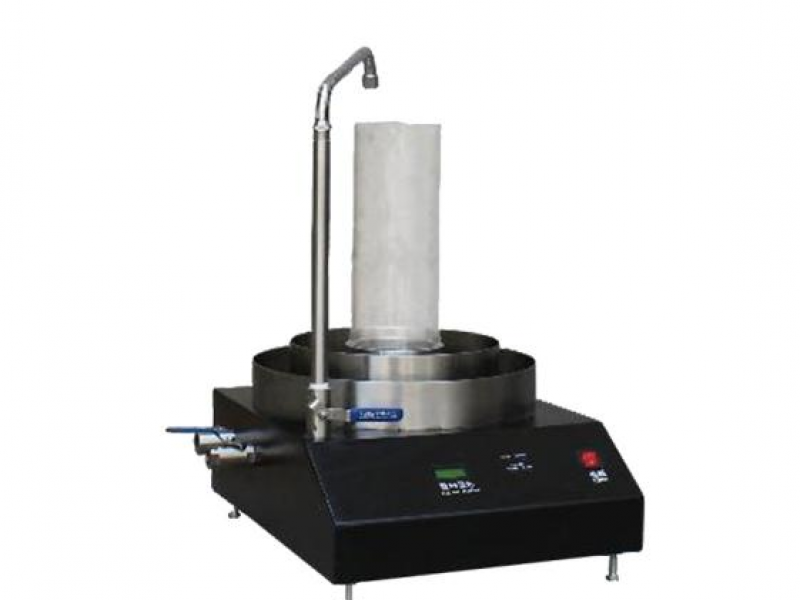
YS080 Hydrostatic Pressure Tester for Geosynthetics
Scope of Application
【Operating Instructions】
- The Hydrostatic Pressure Tester for Geosynthetics (also known as the Anti-seepage Performance Tester) is used to test nonwoven composite geotextiles (such as one geotextile-one geomembrane, two geotextiles-one geomembrane). These are produced with nonwoven geotextiles or other materials as the base fabric, and polyethylene (PE) or polyvinyl chloride (PVC) as the membrane material. It is used to determine the seepage flow rate (i.e., seepage velocity) and specimen thickness under a specified hydraulic pressure difference within a certain time, allowing for the calculation of the permeability coefficient.
YS080 Hydrostatic Pressure Tester for Geosynthetics
Applicable Scope:
The Hydrostatic Pressure Tester for Geosynthetics (also known as the Anti-seepage Performance Tester) is used to test nonwoven composite geotextiles (such as one geotextile-one geomembrane, two geotextiles-one geomembrane). These are produced with nonwoven geotextiles or other materials as the base fabric, and polyethylene (PE) or polyvinyl chloride (PVC) as the membrane material. It is used to determine the seepage flow rate (i.e., seepage velocity) and specimen thickness under a specified hydraulic pressure difference within a certain time, allowing for the calculation of the permeability coefficient.
Compliance Standards:
"Determination of permeability properties of composite geomembranes" GB/T 17642–1998
GB/T 17642-2008 "Geosynthetics - Nonwoven composite geotextiles"
GB/T 19979 "Geosynthetics - Anti-seepage performance"
JTG E50-2006
Instrument Features:
High-definition LCD touch panel with digital display, eliminating manual reading errors.
The test plate is made of SUS304 stainless steel, offering corrosion resistance, easy cleaning, and an aesthetic appearance.
Multi-functional design, capable of conducting both hydrostatic pressure resistance tests and permeability coefficient determination tests.
Surface treatment: Uses American DuPont powder with an electrostatic painting process, cured at a high temperature of 200℃ to ensure long-lasting color retention.
Technical Parameters:
Display: 7.8-inch true color touch screen
Measurement Range: 0 - 4.0 MPa (Accuracy: 0.5%)
Resolution: 0.01 MPa
Water Collector Inner Diameter: 200 mm
Perforated Plate Hole Diameter: 3 ± 0.05 mm
Perforated Plate Hole Spacing: 6 mm
External Dimensions: 700 × 550 × 1650 mm (W × D × H)
Power Supply: AC 220V, 100W
Test Principle:
When the pressure head on both sides of the specimen reaches a certain value, the specimen ruptures. The hydraulic pressure difference on both sides is increased step by step and maintained for a certain period. When the seepage flow increases rapidly, it indicates that the specimen has been damaged, thereby obtaining the hydrostatic pressure value. This machine incorporates two functions: the determination of hydrostatic pressure resistance and the determination of the permeability coefficient.