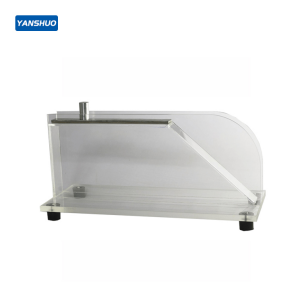
YS-207S Fabric Softness Tester (Manual Type)
Scope of Application
【Operating Instructions】
- Used to determine the bending length of various fabrics using the inclined plane method, from which the bending stiffness can be calculated.
YS-207S Fabric Softness Tester (Manual Type)
Applicable Scope:
Used to determine the bending length of various fabrics using the inclined plane method, from which the bending stiffness can be calculated.
Compliance Standards:
Complies with GB/T 18318.1-2009, JIG 1-1999, and YY/T 0472.2.
Technical Parameters:
Inclined Plane Angle: 41.5° ± 0.5°
Steel Ruler Mass: 250g ± 10g
External Dimensions: 460 × 120 × 250 mm (L × W × H)
Net Weight: 1 Kg
Working Principle:
A rectangular specimen is placed on a horizontal platform with its long axis parallel to the long axis of the platform. The specimen is pushed along the platform's long axis, causing it to extend beyond the platform and bend under its own weight. The extended end hangs in the air, while the other part remaining on the platform is held down by a steel ruler. When the leading end of the specimen passes the front edge of the platform and reaches the inclined plane at an angle of 41.5° to the horizontal, the overhanging length is equal to twice the bending length of the specimen, from which the bending length can be calculated.
Installation and Usage Precautions:
The instrument should be placed on a stable foundation, free from obvious vibration sources. The ambient temperature should be 20℃ ± 15℃, relative humidity < 85%, and the surrounding area should be free of corrosive media and conductive dust.
Do not turn the instrument upside down to prevent parts from falling off, loosening, or deforming.
Operation Instructions:
Place the instrument on a level bench.
Cut the specimen according to the standard (GB/T 18318.1-2009) requirements. The specimen size should be 250mm × 25mm.
Place the specimen on the workbench and align it with the marked line D on the workbench. Then, place the steel ruler so that the "0" mark on the ruler's pressing plate aligns with the marked line D on the workbench.
Push the steel ruler's pressing plate to advance the specimen forward together. Stop pushing the steel ruler when the leading end of the specimen passes the front edge of the platform and reaches the inclined plane at an angle of 41.5° to the horizontal.
Record the scale on the steel ruler corresponding to the marked line D as the overhanging length of the specimen.
Repeat steps 3, 4, and 5 to test the other side of the same specimen.
Note: Position the instrument to facilitate observing the zero point on the steel ruler and the contact between the specimen and the inclined plane, ensuring accurate readings in the horizontal direction.Refer to Section 9 "Calculation of Results" in the standard GB/T 18318.1-2009 to calculate the final test results.